
Making Climate Law Work Podcast
The Energy and Climate Change Law Institute paired up with qLegal to launch a brand-new podcast exploring how legal tools shape climate action in practice.
Get involved
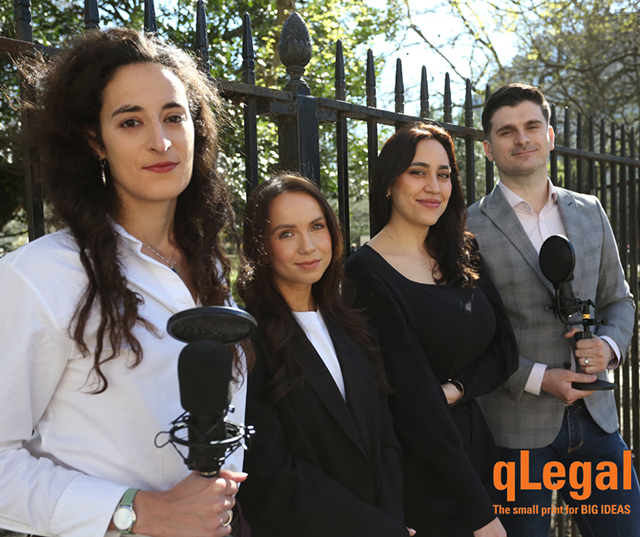 Participation in the Making Climate Law Work podcast is open to successful qLegal students on the Energy and Climate Law LLM. Learn more about how and when to apply, check the qLegal application page.
Selected students will receive weekly training and support from qLegal throughout the podcast production, and regular feedback from the Energy and Climate Change Law Institute. Students also learn professional skills, gain industry exposure, and meet new colleagues.
Participating in the podcast allowed me to try something completely new and explore topical issues in climate law in a fun and engaging way. The friendships formed through the project ended up shaping my entire LLM experience in London.— Alisa Eva Rakel Ainonen, 2025-26 qLegal Podcast Student
Working on the podcast production helped me understand how the legal profession is evolving today, while also allowing me to learn about climate change law from a fresh and different perspective.— Nikola Duper, 2025-26 qLegal Podcast Student
Being part of the podcast gave me the opportunity to work with my friends and tune my climate law knowledge.— Renata Julieta Herrera Garcia, 2025-26 qLegal Podcast student
Producing this podcast has helped me hone the art of communication – a skill that is always expected of a good lawyer. It has been enriching to build this project with my classmates from the LLM programme, where I have gained experience of working with diverse cultures and ways of thinking.— Manuela Motta Zini, 2025-26 qLegal Podcast student
What our guests say
"I really enjoyed being interviewed, Manuela and Julieta were on top of everything and ensured that all feedback was incorporated to ensure a streamlined interview. It was very obvious that, for them, this was not just a requirement to be done, but something they were very passionate about and were excited to learn more.
I joined because it's so important - especially for researchers - to take part in many ways to engage with people who are interested in climate litigation, would like to deepen their knowledge, or just want to know what developments there are in a field that's outside their own.
The impacts of climate change are broad and diffuse, and in the last decade alone, efforts to address them have increased in scope and breadth. Climate litigation is one of those ways, and it's really exciting how far it's gone, and how far it could potentially go." - Jameela Joy Reyes, guest on the “Loss and damage: who is paying the global climate bill?” episode.
About the composition - called Sirens
The melody
The compositions ‘Sirens’ reflects on the powerful forces of nature in this Anthropocene era.
Concluding with a key change and notes of optimism and stability, this brief melody is intended to evoke feelings of; beauty and danger; warning simple humans of the repercussions of their fantastical short-term temptations, and to realistically redress and rebalance their longer-term role on this living planet.
The composer
Isis, a young teen at the time of composing this tune, attends an academy school in Southwest Scotland. Isis was born in East London. Aged 6, she moved to an otherwise uninhabited island with her family and four Shetland lambs, where she was home educated and necessarily gained a daily understanding of life and death through the seasons and the untameable seas. She moved to a village in the county of Dumfries and Galloway aged 8 to attend ‘real / mainland’ school. Her bio is relevant to this composition in the sense that, for her age, she has a thorough understanding of incredibly diverse environments - from one end of the country to the other - from inland man-made metropolises to wild and agricultural, coastal environments.