
Full programme of lab, field, and management on Cairngorms Geography fieldtrip
Students from the Department of Geography and Environmental Science (GES) went on a week’s field trip in the Cairngorms to learn about the issues facing a range of environments and to gain on-the-ground skills that take academic work outside the classroom.
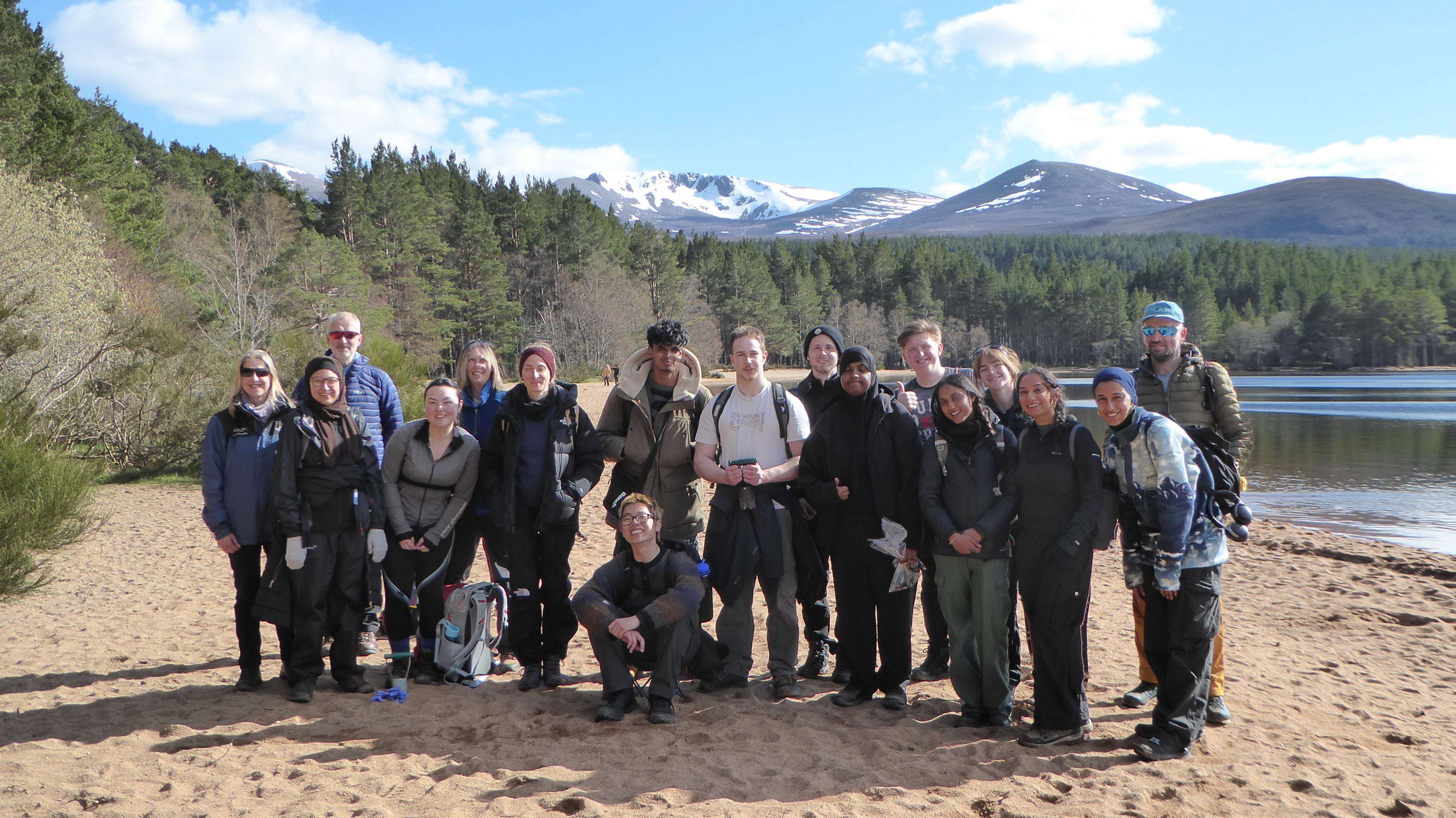
As part of the expedition, students developed foundational fieldwork skills such as geomorphological observation and mapping and taking soil, sediment, water and invertebrate samples from different environments.
Students also heard from professionals working in forestry management and river restoration to learn firsthand about management challenges and work life after graduation.
Professor Simon Lewis, who organised the fieldtrip along with colleagues said: “The Cairngorms is a great location to take students, it is a spectacular landscape, shaped by many different natural processes both past and present. It also has a wide range of rare and important habitats and species.”
Students visited the Allt Lorgy, an award-winning river restoration project, where they met industry experts Hamish Moir (cbec ecoengineering), Ffion Robb and Steve Blow (Spey Catchment Initiative), and Hannah Linton (NatureScot) who spoke about their work on the project.
They also gathered data on physical, biological and chemical properties of the Allt Lorgy to assess its condition and the opportunity to develop professional approaches such a River Corridor Survey, Geomorphic Unit mapping, and Riverfly.
Professor Lewis said: “Many of the activities are relevant to future employment and the students hear from people working in the area utilising the knowledge and skills that we are developing on the fieldtrip.”
The trip is part of the GES’ ‘Fragile Environments’ module that explores issues around environmental management and rehabilitation of geomorphological systems and ecosystems which have been impacted by human activity and are vulnerable to future change.
The students also learned about the impact of human activity in the context of forestry regeneration, mountain environments and peatland ecosystems and activities also included field observation and mapping, soil sampling and analysis, peat coring and measurement of carbon dioxide emissions from soils.
“Being able to spend some time here is always a pleasure and a highlight. The weather was great too, four days of dry, warm and sunny weather. Couldn’t ask for more,” added Professor Lewis.