
Postdoc edition: Dr Avinaash V. Maharaj and Dr Charlotte Johann
Queen Mary is celebrating our postdocs and the contributions they make to research, impact, and culture during National Postdoc Appreciation Week, which runs between 15-19 September.
In this special edition, we asked colleagues, Dr Avinaash V. Maharaj and Dr Charlotte Johann to share their experience of being a postdoctoral researcher at Queen Mary.
Dr Avinaash V. Maharaj
Postdoctoral Researcher, Centre for Endocrinology, William Harvey Research Institute (WHRI)
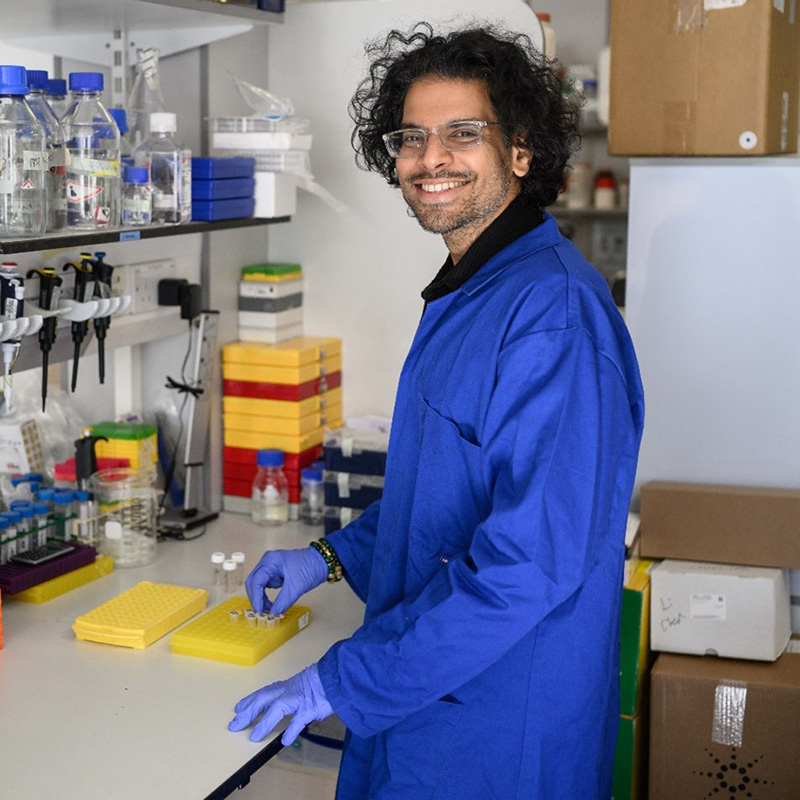
Can you tell us a little bit about yourself and how long you’ve worked at Queen Mary?
If I include my postgraduate education and postdoctoral experience, I have been affiliated with Barts and the London Medical School and the William Harvey Research Institute for 10 years! I initially trained and worked as a clinician in Trinidad and Tobago (my country of origin) prior to switching career paths and delving into Endocrinology research. I sometimes feel like an accidental academic; a short-term foray into postgraduate research in a foreign setting began as an interruption in my clinical training but turned into a full-fledged scientific career.
Describe your average day/week?
It is sometimes hard to predict my workweek, but an average day always starts with coffee and an email-check. If I have experiments planned, I tend to have an early start, otherwise I can have a more relaxed approach to data analysis or academic writing. At this stage of my career, quite a bit of time is dedicated to writing, particularly fellowship applications that can often be challenging to say the least! I am sure all my peers can identify with the grind of compiling funding applications that sometimes feel like a law of diminishing returns.
Tell us about a special project or opportunity that you’ve had a chance to work on recently
Given the high-pressure nature of the postdoctoral experience and the lack of job security, it’s important to appreciate every win, however small, because it can be reassuringly self-validating. My work over the last four years culminated in a publication outlining a new genetic disorder, known as Maharaj Storr Syndrome (Nature Communications, 2024). I described the first human disease-causing mutations in the gene QSOX2, which impact growth and development in children, leading to a rare syndrome involving growth failure, immune deficiency and poor gastrointestinal function. I was extremely honoured to be recognised by the European Society of Paediatric Endocrinology by receiving the Henning Anderson Prize for outstanding scientific research last year. I was also awarded a co-investigator Barts Charity grant to continue work on this disorder and develop feasible treatment options for current patients and those identified in the wake of our discovery. My work was also recently acknowledged by the Faculty of Medicine and Dentistry (FMD) at Queen Mary where I was runner-up for the FMD postdoctoral staff award and nominated for the Queen Mary Research and Innovation – Postdoctoral or Research Fellow award in 2025.
What do you see as your role in helping the University achieve its Strategy 2030?
In addition to continuing to produce world-class peer reviewed research outputs, I am keen to continue my teaching involvement at QMUL, delivering lectures for the Fundamentals of Medicine undergraduate course and the postgraduate taught Master's in Clinical Endocrinology. I feel strongly about inclusivity in academia and will continue mentoring young undergraduates from underrepresented backgrounds, who aspire to careers in science.
What is your favourite place on any of our campuses?
I think this might be unanimous for everyone at the WHRI, but it would have to be the Charterhouse Square lawn. It’s a bit of urban greenery that lends itself to relieving stress (mine at least) and a great setting for social events.
What would you want new postdocs to know about working at your school or institute?
Working at the Centre for Endocrinology has its ups and downs, largely due to our lab space warranting a much-needed refurbishment, but our department is a close-knit community, with a true sense of congeniality. Our communal workspaces are usually quite animated and yet relaxing, knowing that you’re amongst friends.
Do you have any hobbies or pastimes outside of work?
I have a few, but I think the ones that keep me sane are running and returning to the Caribbean at every given opportunity.
Dr Charlotte Johann
Leverhulme Early Career Fellow, Department of History, School of Society and the Environment
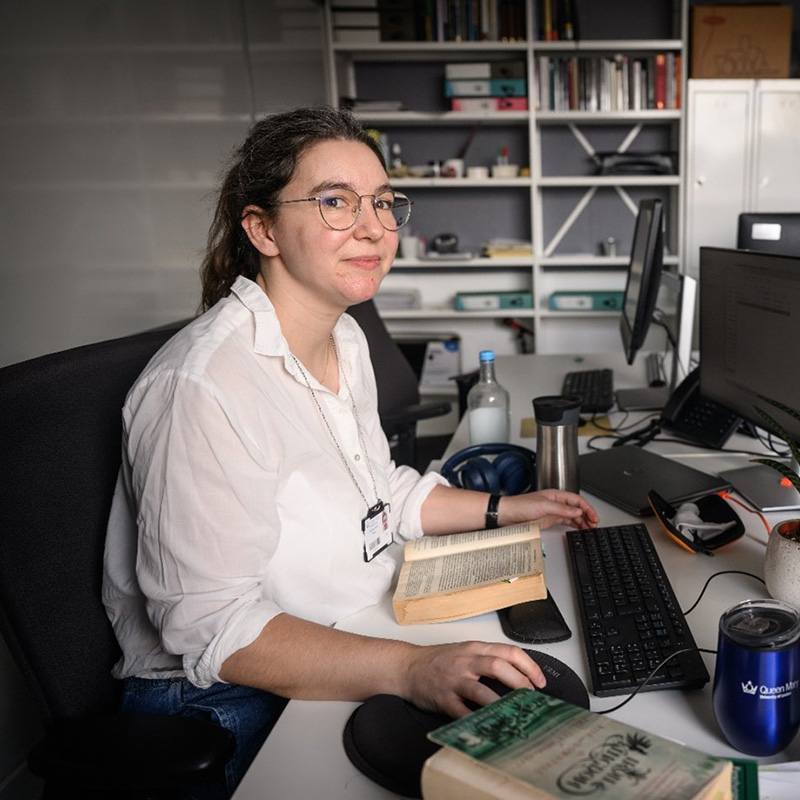
Can you tell us a little bit about yourself and how long you’ve worked at Queen Mary?
I joined Queen Mary just over a year and a half ago as a Leverhulme Early Career Fellow in history. I am originally from Germany and finished a degree in political science in Berlin, then moved to the UK for a masters’ and PhD at the University of Cambridge. Before moving to London, I spent a few years as a research fellow at Churchill College, Cambridge.
My work explores how legal scholars think about order in the long nineteenth century – the period late 1780s until the start of the first World War (1914)– particularly in Germany and the British Empire. I investigate the different and often conflicting ways people imagined the legal order in an age shaped by state building, revolutions, mass warfare, social change and imperial expansion. Lawyers had to find ways to navigate these conflicts, and make the legal system work despite all these tensions, both on the national and international level. My work uncovers the techniques they developed to do so. My background is in intellectual history, but I often draw on government and court records to show how ideas about law played out in practice.
Describe your average day/week?
As a research fellow in the humanities, I work on my own research projects rather than in a team, which means that I have a lot of freedom in how I allocate my time. This means I alone am responsible for deciding the course of my research, setting priorities and imposing deadlines.
I try to spend three to four hours a day writing, unless I am travelling to do archival research or attend conferences. The rest of my time is dedicated to working through sources and academic literature, organising or preparing for events such as seminars, workshops or conferences, and teaching.
Tell us about a special project or opportunity that you’ve had a chance to work on recently
I recently presented my work at the Hart Workshop on the history of jurisprudence organised by Maks del Mar, who is based in the School of Law, and Michael Lobban at Oxford. It was great to meet and discuss my work with legal historians from all over the UK and beyond. One of the great things about being in London is that everyone comes through here at one point or another, and there’s no shortage of opportunities to meet people, from fellow postdocs to senior scholars.
In addition to my research, I represent humanities early career researchers on a group that works to align Queen Mary’s practice as a signatory to the Researcher Development Concordat. The RD Concordat is a set of principles that guides research staff employment, development, organisational culture, and environment. This work means that I connect as much as possible with other postdocs in the faculty, and communicate their interests and needs to the University. A great opportunity to do this was attending and presenting at the recent Postdoc Congress in June, an annual event hosted by the University.
What do you see as your role in helping the University achieve its Strategy 2030?
Postdoctoral researchers are essential to a university’s research output, as well as growing and maintaining a good research culture, which are integral parts of both the University’s strategy and the next Research Excellence Framework. It is important for postdocs to support one another and build a community of early career researchers across schools and faculties, but also for the University to support us in this work. We are, after all, the future of the academic sector.
What is your favourite place on any of our campuses?
On nice days, I love to get a salad bowl from the Curve and have lunch by the canal.
What would you want new postdocs to know about working at your school or institute?
The Department of History is a phenomenal place to do research. It has a wonderful community of world-class scholars who cultivate a genuine spirit of collegiality and support one another in putting out the best possible work. I can only recommend it as a place for an early career fellowship. The Centre for the Study of History of Political Thought weighed heavily on my decision to apply here, but there are many other brilliant research institutes, lecture series and other initiatives attached to the Department.
Do you have any hobbies or pastimes outside of work?
Having routines outside of work, especially when it comes to exercise, is an important part of my postdoc life. But since moving to London, I have also enjoyed spontaneous exploration of what the city and especially the East End neighbourhoods have to offer, from Indian food in Wanstead, to afternoons reading in Vicky Park and community sauna sessions in Hackney.
Postdoc Appreciation Week 2025
Between 15-19 September we're celebrating Postdoc Appreciation Week! Let a postdoc know how they’ve made a difference to you or your research by leaving them a message. There are also events organised throughout the week, including workshops and training opportunities. Visit the Queen Mary Academy website for programme details.