
Shifa Idris (BEng Computer Systems Engineering, 2025)
One day you’re coding, the next you’re working with hardware or thinking about how entire systems fit together.
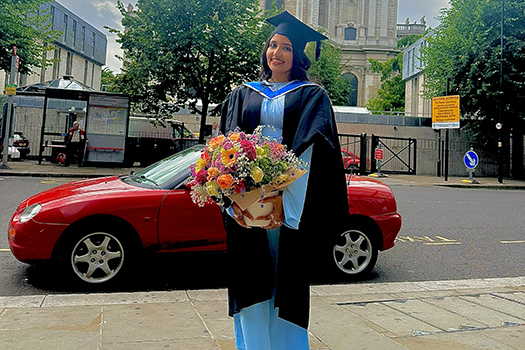
Why did you choose to study your programme?
Computer Systems Engineering felt like the perfect middle ground between hardware and software understanding everything from circuits to code. I’ve got to take things apart to see how they work (and had mixed success when putting them back together). I liked that it kept my options open and meant I wouldn’t be stuck doing just one thing.
Why did you choose to study at Queen Mary?
Queen Mary stood out for its strong engineering reputation and the fact it’s a Russell Group university, so you know you’re getting a high standard of teaching and research. I also liked the balance between theory and hands-on work. Being in London was another big plus there’s something motivating about studying in a city where so much is happening (and the food options definitely helped).
What did you most enjoy about your course?
The variety, definitely. One day you’re coding, the next you’re working with hardware or thinking about how entire systems fit together. It kept things interesting and meant there was always a new challenge. Also, that feeling when something finally works after hours of debugging is still one of the most satisfying parts.
Can you share an example of a project, assignment, or activity that stood out to you?
My final year project was probably the highlight. I built a real-world driving simulator that incorporated machine learning and AI. As a big Formula 1 fan, it was really exciting to work on something that felt connected to real racing and driver behaviour. It was one of those projects where everything I’d learned came together, and it actually felt like “real” engineering.
Which modules did you enjoy the most and were there any academics that had a strong influence on shaping your time and studies here?
I really enjoyed modules that combined theory with practical application, especially anything involving embedded systems or intelligent systems. The academics who stood out most were the ones who made complex topics feel approachable and clearly cared about what they were teaching. It makes a big difference when that enthusiasm rubs off on you.
Describe your career path since graduating.
After graduating, I began my career as a Graduate Engineer at Transport for London. In this role, I’ve been working on signalling and customer information systems, focusing on data analysis, fault investigation, and performance improvement across critical transport infrastructure. This position has allowed me to apply my technical knowledge in a real-world, safety-critical environment while continuing to develop my analytical and problem-solving skills. I am particularly interested in roles that combine data analysis, engineering, and high-performance environments, and I am working towards building a career that aligns with these interests.
How has your degree remained relevant throughout your career and are there any particular areas of your degree that you use in your day-to-day job?
My degree has remained highly relevant, particularly in developing strong analytical thinking and problem-solving skills. Modules such as large data processing, machine learning, and systems engineering are directly applicable to my current role, where I regularly analyse operational data to identify trends and diagnose faults. Programming experience has also been valuable when working with technical systems and interpreting complex datasets. Beyond technical knowledge, the degree taught me how to approach large, real-world problems methodically, which is something I rely on every day in a fast-paced engineering environment.
What's one piece of advice you'd offer to someone considering studying your programme at Queen Mary?
Take full advantage of opportunities beyond your coursework, as these experiences are what really help you understand how your skills apply in the real world. For example, joining Formula Student gave me valuable hands-on engineering experience, strengthened my teamwork in a high-pressure environment, and played a key role in developing my passion for motorsport. Also make sure you tailor your final-year project to something you are genuinely interested in. It’s a great opportunity to explore your passions while showcasing your key technical skills such as problem-solving, programming, and data analysis. Choosing a project aligned with your interests not only makes the process more engaging, but also helps you stand out to employers and can shape your future career direction.